-
Annual
Integrated Report 2021/22The Central Bank of Eswatini (the CBE or the Bank) is pleased to present its Annual Integrated Report (Report) for the year ended 31 March 2022. The Report forms part of the CBE’s public accountability, transparency and responsibility to a broad range of stakeholders.

Highlights
7.9
Percent
As measured by real Gross Domestic Product (GDP) is estimated to have grown by 7.9 per cent in 2021 from a 1.6 per cent contraction in 2020.
3.7
Percent
Annual headline inflation averaged 3.7 per cent in 2021, slightly lower than the 3.9 per cent recorded in 2020.
2.6
Months
Reserves' import cover at 2.6 from 4 Months recordedat the end of March 2022.
1.3
billion
Eswatini recorded an overall balance of payments deficit of E1.294 billion 2021, lower than the E1.712 billion deficit recorded in the previous year.
Monetary Policy
The Bank has the goal of attaining price stability as well as stable and sound financial systems that will ensure sustainable economic growth. Eswatini's monetary policy objective, as stated in Section 4 (a) of the CBS Order of 1974 (as amended), is to promote price and financial stability. Monetary policy formulation is, to a large extent, influenced by the country's membership to the Common Monetary Area (CMA). To influence monetary conditions in the country and achieve its mandate, the Bank uses four different tools – namely, discount rate (which happens to be the major one), reserve requirement, liquidity requirement and open market operations.
33
Page
Monetary Policy
34
Page
MPCC Terms of
Reference
34
Page
Inflation
Outlook
Our Business Model
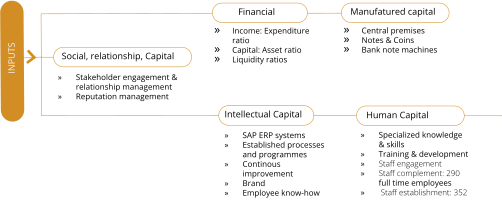
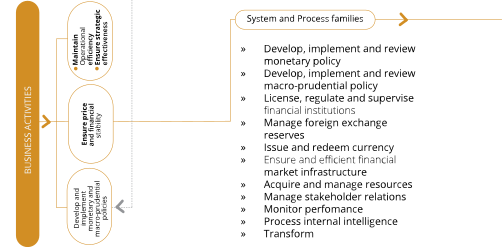
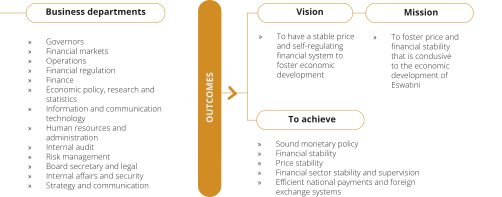
The Bank uses monetary and macro-prudential policies to drive the achievement of both price and financial stability within Eswatini. Our Mission captures the mandate of the Bank. Through our Vision, we have defined a desired future state that enables us to continue to deliver on the mandate. The Bank’s strategy seeks to drive operational efficiency and strategic effectiveness. This means striking a balance between running the business and changing it. Operations run the organisation whilst strategy transforms it. We run our operations through business processes / systems and we execute our strategy through programmes.